Hi, I’m Dan.
Searching for the final frontier.
I’m fascinated by how technology changes our ability to organise people, capability and value — and what new systems become possible when it does.
I’ve spent nearly 30 years getting hands-on with those shifts: building inside them, making sense of what changes, and sharing what I learn so other people can act on it.
Right now, I’m doing that with AI.
I’m the founder of Vee.
I also work with founders, organisations and boards where technology is changing the rules.
What drives me
Technology is interesting. What it lets people do is more interesting.
I’m fundamentally optimistic about people’s ability to make things better. I love seeing people turn an idea into something real — particularly when technology gives them an ability they didn’t have before.
That’s probably the thread behind a lot of my career. I’ve been drawn to technologies that shift who gets to participate, what they can build, how they can organise and how value gets created.
Founders have always pulled me close to that edge. They’re often the people turning a new capability into the next product, company or way of working — which is why I’ve spent so much of my career building ventures, supporting founders and creating some of the communities, accelerators and ecosystems around them.
And once I’ve learned something useful, my instinct is usually to share it — through mentoring, writing, programmes, communities, or building some of the infrastructure that helps other people get started.
The technology changes. That part hasn’t much.
How I learn
I get close enough to find out.
I've never been content understanding change from the sidelines.
I tend to get inside it: build something, see what breaks, form a view, challenge it, and work out what the second-order effects might be.
Then I share what I’m learning. Partly because it might help someone else; partly because good disagreement is one of the fastest ways I’ve found to discover where I’m wrong.
Some rabbit holes have proved considerably more useful than others. That’s probably the price of exploring them before the map exists.
THE MAP SO FAR
Current map · Aug 2026Four shifts I’ve been lucky enough to build inside.
Looking back, I don’t think the technologies themselves were ever really the point. Each one moved an underlying constraint on what people could do — and opened a new question about how we might connect, organise capability and create value.
Plenty happened between these waves. These are just the shifts that most changed the questions I found myself asking.
-
What if everyone could connect?
INTERNET · 1990s — CONNECTION + INFORMATION BECOME ABUNDANTThe internet made information and connection radically cheaper. Geography suddenly mattered much less to who you could find, what you could share and what people could build together.
I built early internet products and helped build SmartGroups, where two million people created and ran their own online communities.
What stayed with me: connection was only the beginning. The interesting question was what people would do once the network became part of everyday life.
-
What if the network was always with you?
MOBILE · 2000s — ACCESS BECOMES UBIQUITOUSMobile took the internet from somewhere you went to something you carried.
At SmartGroups I worked on one of the earliest mobile social-network experiences, getting a first-hand look at what changed when online communities began spilling into everyday physical life.
What stayed unresolved: connecting people at scale had become dramatically easier. Coordinating them — particularly around ownership, incentives and value — was still largely controlled by platforms, institutions and whoever held the money. That became the next question.
-
What if coordination and value could be programmed?
DECENTRALISATION · 2010s — COORDINATION + VALUE BECOMES PROGRAMMABLEWeb3 put coordination and value up for redesign. Could software let groups organise ownership, incentives and exchange without everything flowing through central institutions?
I explored that through DAOs, crypto-economics and community ownership. Plenty overpromised; the questions about participation, ownership and where value flows didn't go away.
What moved next: what if software could provide the capability, not just coordinate it?
-
What if capability itself could live in software?
AI · NOW — KNOWLEDGE + EXECUTION BECOMES PROGRAMMABLEAI is beginning to make knowledge and execution programmable.
I’m building inside that shift now, exploring what happens to companies when meaningful amounts of capability no longer have to live exclusively in people.
Which leaves me wondering: what happens when software can not only work, but increasingly create, allocate and compound economic value?
-
What if economic agency becomes programmable?
NEXT FRONTIER? — AN OPEN QUESTION
It’s the next question I can see forming beyond the current one: what happens to entrepreneurship, personal agency and wealth creation when productive capability is no longer tightly coupled to human labour or organisational scale?
The interesting part has never really been the technology. It’s what becomes possible for people when the underlying constraints move.
Where I am now
Right now, the frontier is AI.
We’re getting much better at giving software the ability to do things that previously required people. I’m interested in what happens one layer above that.
If more of a company’s capability can live in software, how does the company itself change? How does it learn? Where does judgement sit? What remains human?
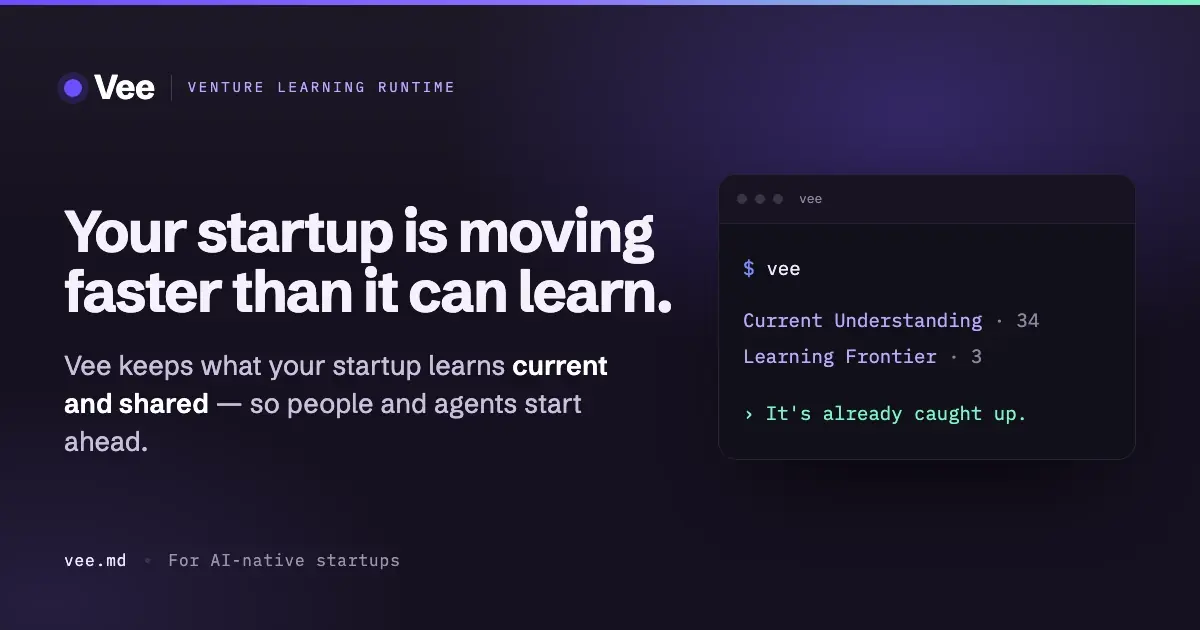
Most of my own building right now is Vee — a venture intelligence layer for founders. Vee is partly a product and partly how I’m getting close enough to this shift to learn something useful: exploring how a company can retain what it learns, understand why it believes something, and change its understanding as the evidence changes.
What I’m trying to understand
The questions I’m carrying right now.
Building inside a frontier tends to produce better questions faster than it produces answers. These are the ones I’m currently trying to get less wrong.
-
01 — What does an AI-native company actually look like?
Adding AI to today’s organisation is different from designing an organisation around what AI makes possible.
-
02 — If execution becomes abundant, what becomes scarce?
Constraints rarely disappear. They move. I’m interested in where judgement, attention, learning and accountability go next.
-
03 — How does a company remember what it has learned?
Moving faster isn’t much use if the organisation keeps losing the evidence, reasoning and context behind its decisions.
-
04 — What becomes the founder’s job?
If more execution can move into software, the founder may need to spend less time managing the work and more time designing the system that learns what work matters.
Thinking about any of the same questions?
I’d genuinely like to hear where you think I’m wrong — or what I’m missing.
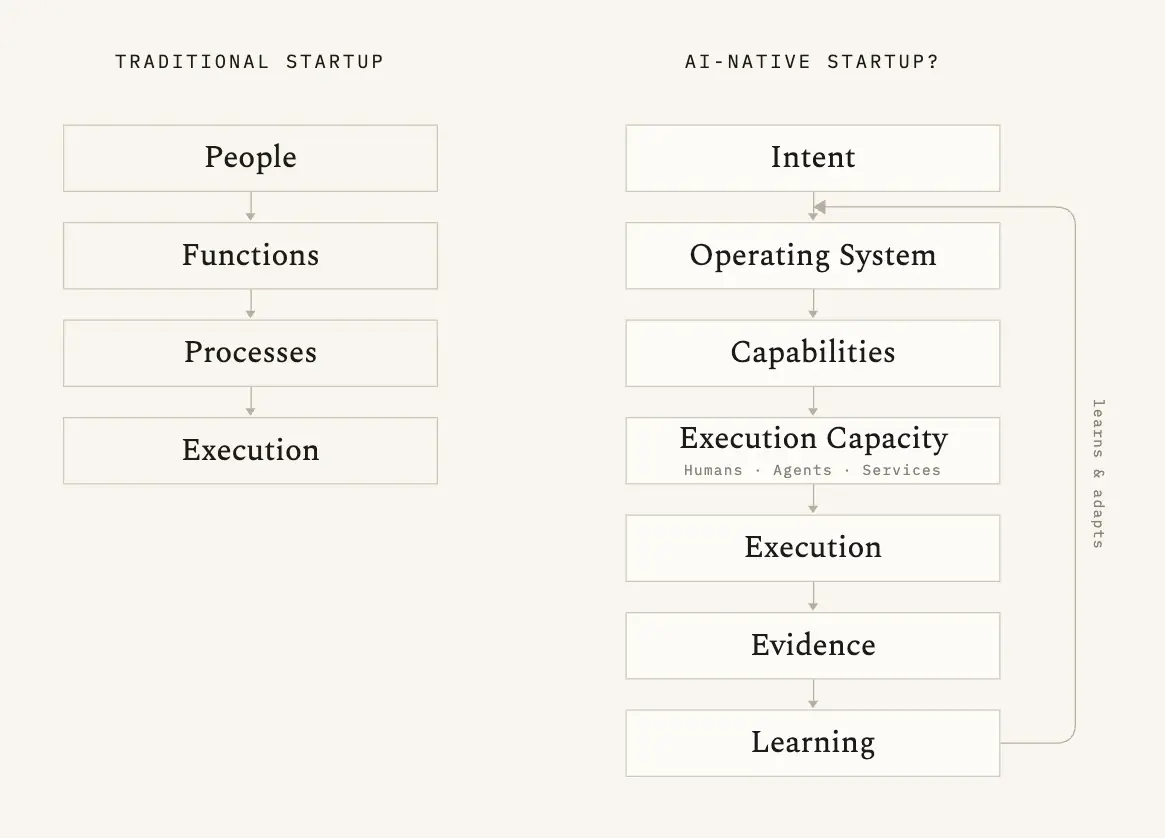
The Company Is Becoming Software
A field note from building inside this shift: what happens when more of a company’s capability moves from departments into software?
Working together
I like keeping one foot outside my own company.
Building Vee is one way I stay close to the frontier. Working with other founders, organisations and boards is another.
I value those engagements because they expose me to problems and perspectives I won’t encounter inside my own company — and give me somewhere useful to apply what I’m learning in very different contexts.
Alongside building Vee, I deliberately keep space for the right founder, strategic and governance work.
Founders
I’ve built companies myself and spent years helping other founders through the uncertainty of starting something new. Through ZeroPoint Ventures, I work with founders on strategy, product, technology and the messy zero-to-one work of figuring out what actually matters.
Organisations
I work with organisations where technology or AI is beginning to change the assumptions underneath the current strategy, business model or operating model. I’m most useful when the implications aren’t yet obvious and the question is bigger than simply which technology to adopt.
Boards
I bring a builder’s perspective to governance — particularly where technology, innovation and AI are becoming strategic questions about the organisation’s future rather than simply operational concerns. My governance experience sits alongside nearly thirty years of building technology, products, ventures and the systems around them.
Think I could be useful? Get in touch →
The human bit
A little about me.
I grew up in the UK in the 80s, in that slightly feral Gen X way where you got sent outside and worked out what to do with whoever else was there.
I sometimes wonder whether that’s where some of my comfort with autonomy came from — figuring things out without instructions, making your own fun, connecting with whoever was around, and building something out of whatever you had.
It might also explain some of my lifelong obsession with making things, communities and figuring things out together. Or maybe that’s retrospective storytelling. Hard to know.
These days I’m in Wellington with my family. I’m a dad, gamer and lifelong sci-fi nerd; I cook a lot of Indian food, drink tea over coffee, and will happily disappear down an interesting rabbit hole for considerably longer than is sensible.
If you’re considering working with me, I’ve written a slightly more useful version of this: How I work →